Bigger is not always better
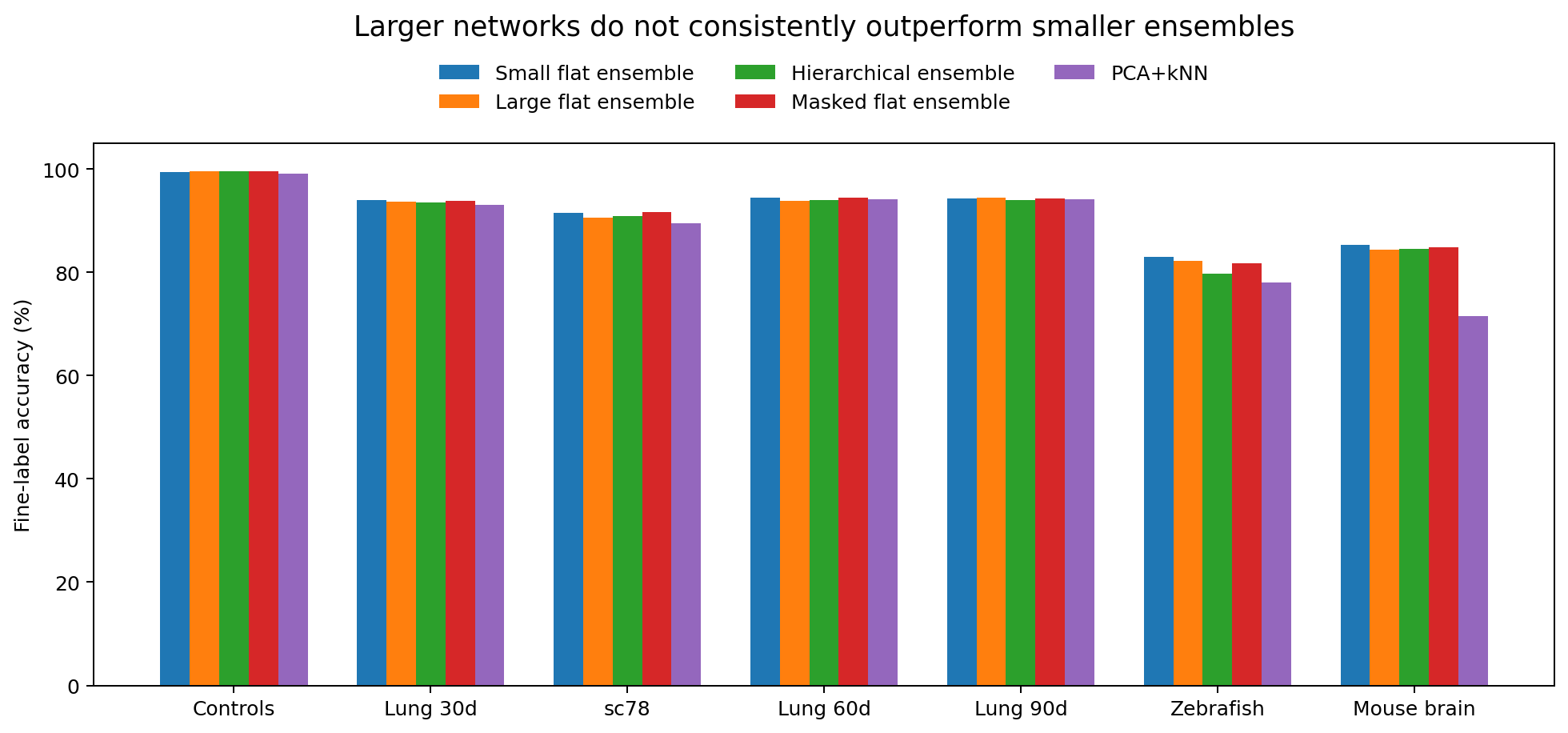
Three-seed neural ensembles are compared with PCA+kNN. The small flat ensemble has the best ordinary accuracy on mouse brain and zebrafish; hierarchy is strongest on mouse-brain balanced accuracy.
Find the supported reference, inspect the cell type, and keep the broad label when the fine answer is uncertain.
Loading reference display…
| Cell | Reference | Accepted annotation | Depth | Status |
|---|---|---|---|---|
| Upload a matrix to inspect cell-level predictions. Gray map points are training-reference cells, not uploaded results. | ||||
Seven primary references. 108 neural fits. Twenty directed lung transfers. Reference-label agreement, not independent biological validation.
Three-seed neural ensembles are compared with PCA+kNN. The small flat ensemble has the best ordinary accuracy on mouse brain and zebrafish; hierarchy is strongest on mouse-brain balanced accuracy.
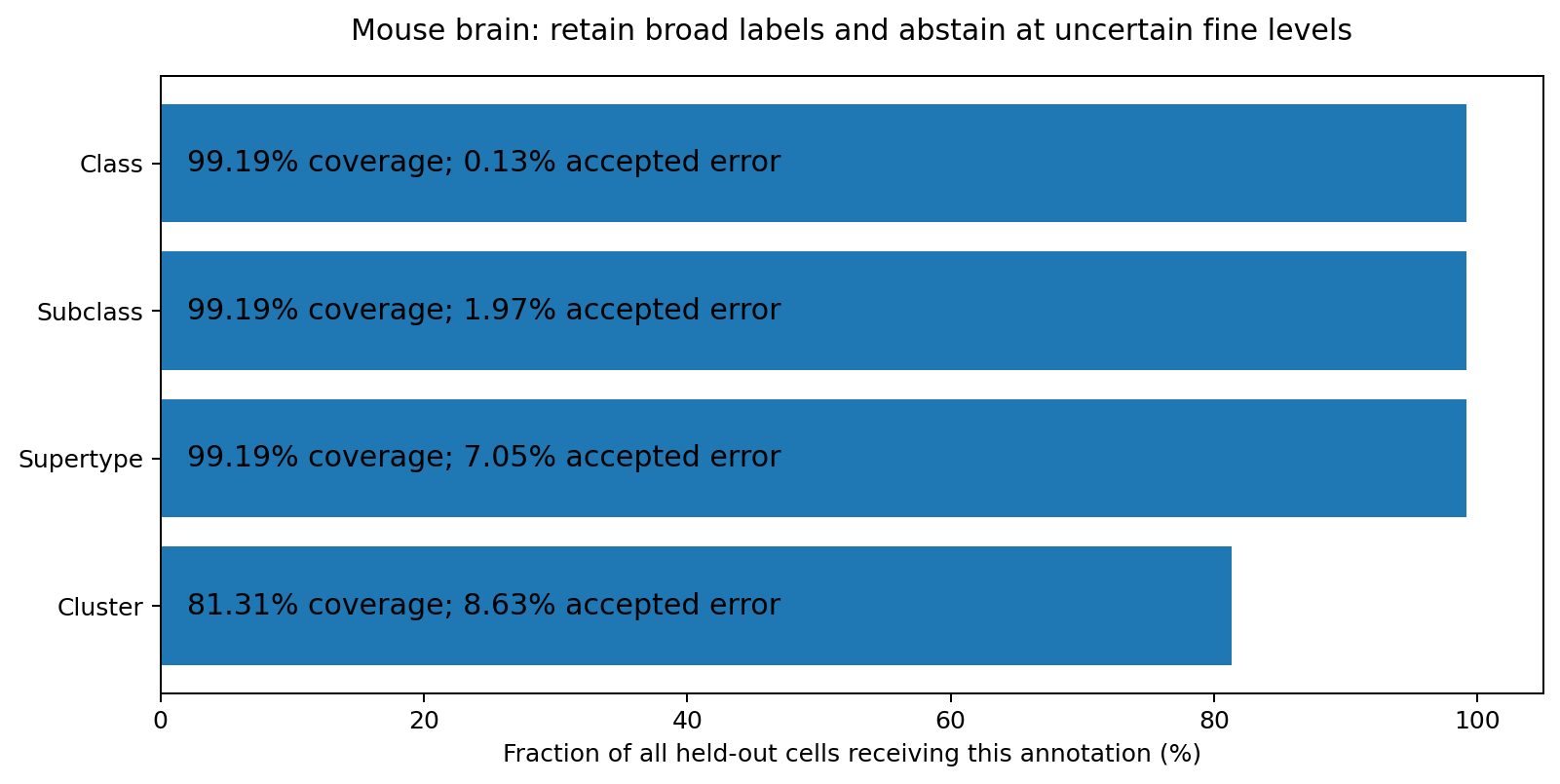
The selected mouse expert accepts broad class labels for 99.19% of the holdout, at 0.13% error among accepted assignments. Fine cluster coverage is 81.31%, with 8.63% accepted error.
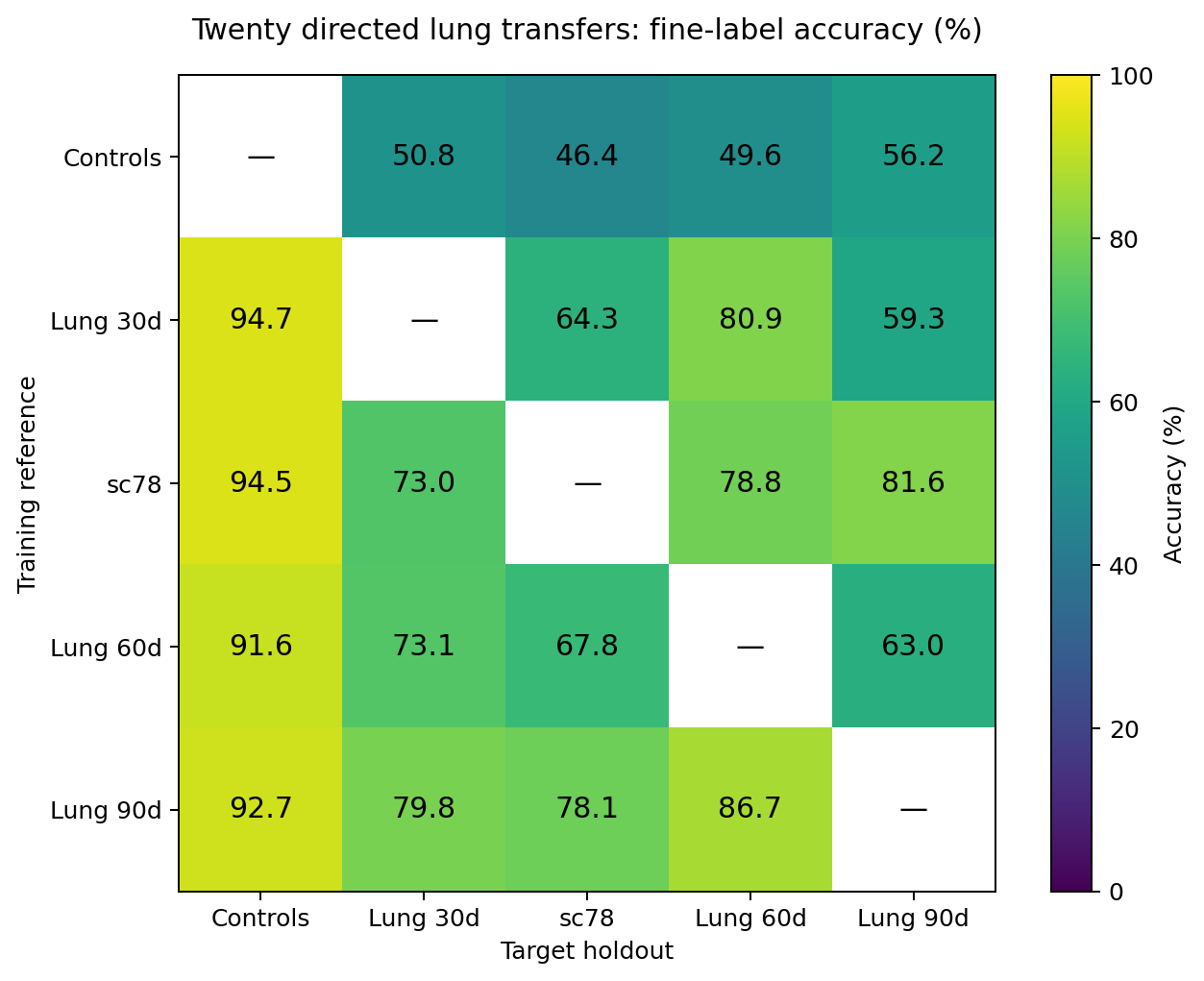
Aligned gene identifiers are not equivalent expression scales. A controls-trained model accepts every tested 60-day target cell at the fine level despite 50.44% accepted-path error.
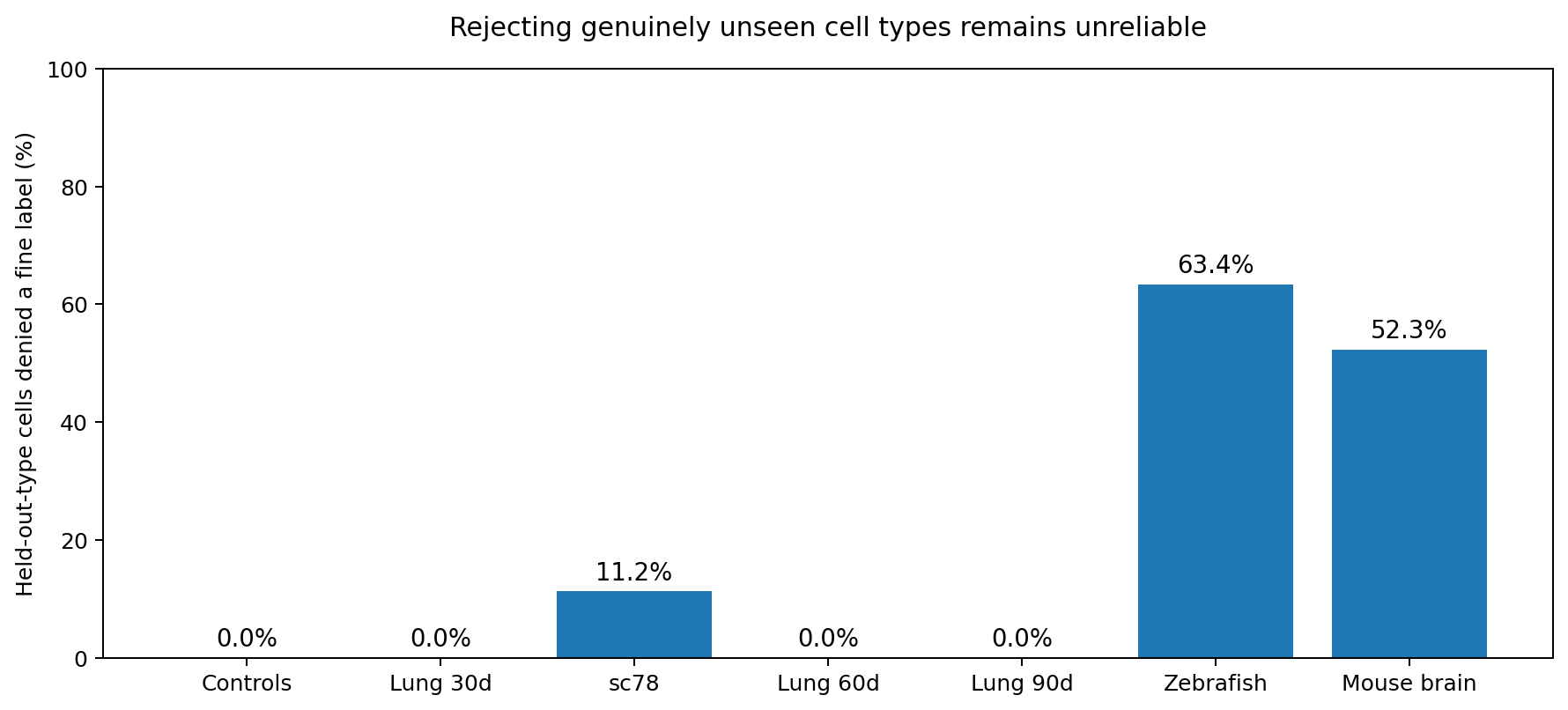
Four of five lung held-out-type tests reject none of the unseen fine types. Good within-reference calibration does not establish dependable novelty detection.
The follow-up compares small flat, large flat, shared-trunk conditional hierarchical and gene-masked flat networks. It includes six sample/library holdouts, seven held-out-type tests and five leave-one-lung-file-out tests. The earlier 414-specialist hierarchy is a separate historical experiment, not the same architecture.
Methods are selected on tuning balanced accuracy. Test outcomes are not used to replace a selected expert. The follow-up was informed by earlier results; training seeds are not biological replicates, and sample/library groups are not assumed to be donors.
Data source: the completed v2 archive and independent review. The public application deploys selected experts—not every research fit. Detailed diagnostics and model identity are exported with each query.
Use UTF-8 CSV with cell_id in the first column and exact gene identifiers in the header. Rows are cells. Or use a JSON object mapping exact genes to numeric values for a single cell. Up to 200 cells, 50,000 genes, 10 million values and 64 MiB per run.
cell_id,gene_A,gene_B,…
cell_1,1.23,0,…
cell_2,0,4.56,…
At least 90% of the relevant selected panel must be present. Duplicate identifiers, ambiguous mapped duplicates, blank/nonfinite values and missing headers are rejected. A measured zero is different from an unmeasured gene. Missing selected genes are imputed using training means. The code does not silently transpose matrices.
Explicit mouse symbol/Ensembl associations harmonize identifiers. A shared-panel, three-member rank-based neural ensemble screens mouse lung versus brain. A separate panel compatibility rule handles zebrafish; it is not a learned species probability. Inputs compatible with both or neither panel are not forced into a family.
The mouse routing confidence is a calibrated model score over those two families—not proof of tissue origin or a probability over all tissues. Reference-support scores describe empirical compatibility with the source; they are not tissue posteriors.
Child experts are selected using tuning balanced accuracy: a large flat ensemble for pooled lung, and masked-flat ensembles for mouse brain and zebrafish. This is not the historical specialist cascade. The optional PCA+kNN mode uses the same fitted reference bank with its own saved calibration and gates.
A greedy taxonomy-consistent path is accepted only while confidence and support requirements pass. A broad label can remain even when a fine label is withheld. Thresholds are frozen, not adjustable to make a query pass.
The map displays a fixed sample of training-reference cells. A PCA map uses the first two fitted PCA axes. When UMAP display maps are installed, query locations are inverse-distance barycenters of eight reference neighbors in PCA space—not a new query UMAP and not UMAP.transform.
Reference families have separate coordinate systems. The map is a visualization, not an accuracy test. A cell may appear among reference points while still being rejected by high-dimensional support checks.
The initial release expects the expression convention used by each reference. Raw counts, log2 expression, log1p expression and z-scores are not interchangeable. Neither a high overlap score nor a plausible plot verifies normalization equivalence. Do not use this prototype for clinical decisions or claim that it reliably detects arbitrary novel cells.
Unknown-type tests and external transfers demonstrate confident mistakes. A model’s accepted label is a research output, not a biological ground truth.
Inference runs in a dedicated worker on your device. The application contains no query-upload endpoint, trackers or analytics. Hosting still receives ordinary page/model-download requests. Exported model weights, reference embeddings, labels and any installed demo samples are publicly downloadable assets. Do not upload confidential human data to a public or shared computer.
Bence Lukacsy · Stony Brook University · CSE 495/496 honors project · Adviser: Professor Scott Stoller. This independent research prototype is not an endorsed university or clinical service. Data, model and reference-asset redistribution must comply with the source permissions.
Deployment model card ↗ · Release checks ↗ · Source and method notes ↗